Keywords AI
Top 8 platforms & frameworks for building AI agents in 2025
AI agents are becoming the next big thing in tech. Y Combinator recently highlighted how vertical AI agents - specialized AI tools focusing on specific business tasks - could become 10 times bigger than traditional SaaS companies. Why? Because these AI agents can automate complex business tasks more efficiently than ever before.
The numbers speak for themselves. According to MarketsAndMarkets, the AI agents market is worth $5.1 billion in 2024 and is expected to reach $47.1 billion by 2030. The best part? You no longer need to be an AI expert to build an AI agent. Thanks to new platforms and frameworks, anyone can create their own AI agent, even without coding experience.
In this blog, we'll explore the top 7 platforms and frameworks that are making AI agent development accessible to everyone:
- Lyzr AI: A low-code agent framework for building Private & Secure GenAI applications faster.
- Autogen: Microsoft's solution for creating multiple AI agents that can work together to solve complex problems.
- Dify: A user-friendly platform with visual tools for building AI applications, perfect for both developers and non-technical users.
- LangGraph: A LangChain extension that helps create stateful, multi-agent systems with advanced planning capabilities.
- Swarm: OpenAI's experimental framework for simple and lightweight multi-agent orchestration.
- LlamaIndex: A data framework that helps connect large language models with various data sources efficiently.
- LangChain: A popular framework for building complex AI applications by connecting different language models and tools.
Let's dive deeper into each platform and see which one is right for your needs.
What are AI agents?
AI agents are software programs designed to perform tasks on their own, without needing constant human supervision. They observe their environment, process information, make decisions, and take action to achieve specific goals. In simple terms, an AI agent works like a smart assistant that can handle tasks intelligently and efficiently.
Think of an AI agent as a smart digital assistant that can:
- Understand its surroundings through data collection
- Make decisions based on the information it gathers
- Take actions to accomplish assigned goals
- Learn and improve from its experiences
1. Upsolve AI: A no-code/low-code agent platform built for SQL-based data analysis capabilities

Upsolve AI is the go-to agent building platform for delivering a highly context-relevant conversational analytics experience rooted in SQL data analysis capabilities. If your agent must reliably parse and query complex structured data, Upsolve is your solution.
Move beyond basic Text-to-SQL. With sophisticated RAG pipelines, a comprehensive evaluation hub, and pre-built data tools designed for advanced analytics, the Upsolve platform allows you to build, test, deploy, and iterate data-capable agents all in one place.
Upsolve empowers developers to leverage a toolkit that includes:
- Business-Context Relevant Question Clarification: Ensures the agent understands the user's intent.
- Chart and Insight Generation: Automatically visualizes data and surfaces key findings.
- Action Triggers: Converts data analysis into immediate, actionable steps.
Particularly beneficial for customer-facing use cases where mission-critical data must be analyzed fast, Upsolve allows you to create autonomous, multi-agent workflows with reliable, data-driven decision-making abilities.
Key Features:
- Direct Data Connectivity (40+ Providers): Connect directly to over 40 database providers. No complex data engineering required—get the platform running with your data in minutes.
- Comprehensive AI Management System (AIMS): A central hub for managing data connection, permissioning, RAG configuration, context, system prompts, and semantic layer definition, all with robust version control.
- Systematic Agent Testing & Evaluation: Use the testing sandbox to trace and evaluate every agent response. Deploy with clarity and confidence by ensuring accuracy and reliability.
- Flexible Frontend Deployment: Embed the data agent across your platform using light-weight formats, including an Out-of-the-Box (OOTB) customizable dashboard, embeddable widgets, and a dedicated Slack agent.
- Bridges Technical & Business Users: The no-code platform is built for easy observability and fine-tuning by business stakeholders, while engineering teams benefit from simple 1-line SDK deployment.
- Best-in-Class Data Security: SOC2 Type 2 certified with HIPAA certification pending, ensuring your business-critical data is secure.
Best For:
- CTOs and CPOs - Deploy a reliable, high-value "chat to your data" customer experience that differentiates your product.
- CAIOs - Leverage large-scale structured data and unlock access for non-technical business users through conversational (natural language) analytics.
- Enterprises - Organizations that handle business-critical events, transactions, and customer records who need fast, accurate data interaction across varying user asks.
In short, Upsolve AI simplifies the creation and deployment of highly customized, AI-driven, and conversational analytics experiences for your end-users, freeing up product and engineering teams from building and maintaining traditional, static dashboards.
What makes AI agents special is their ability to be rational and autonomous. They can process information, make informed decisions, and take actions without constant human supervision. This makes them powerful tools for automating tasks, handling large amounts of data, and scaling operations efficiently.
2. Lyzr AI:
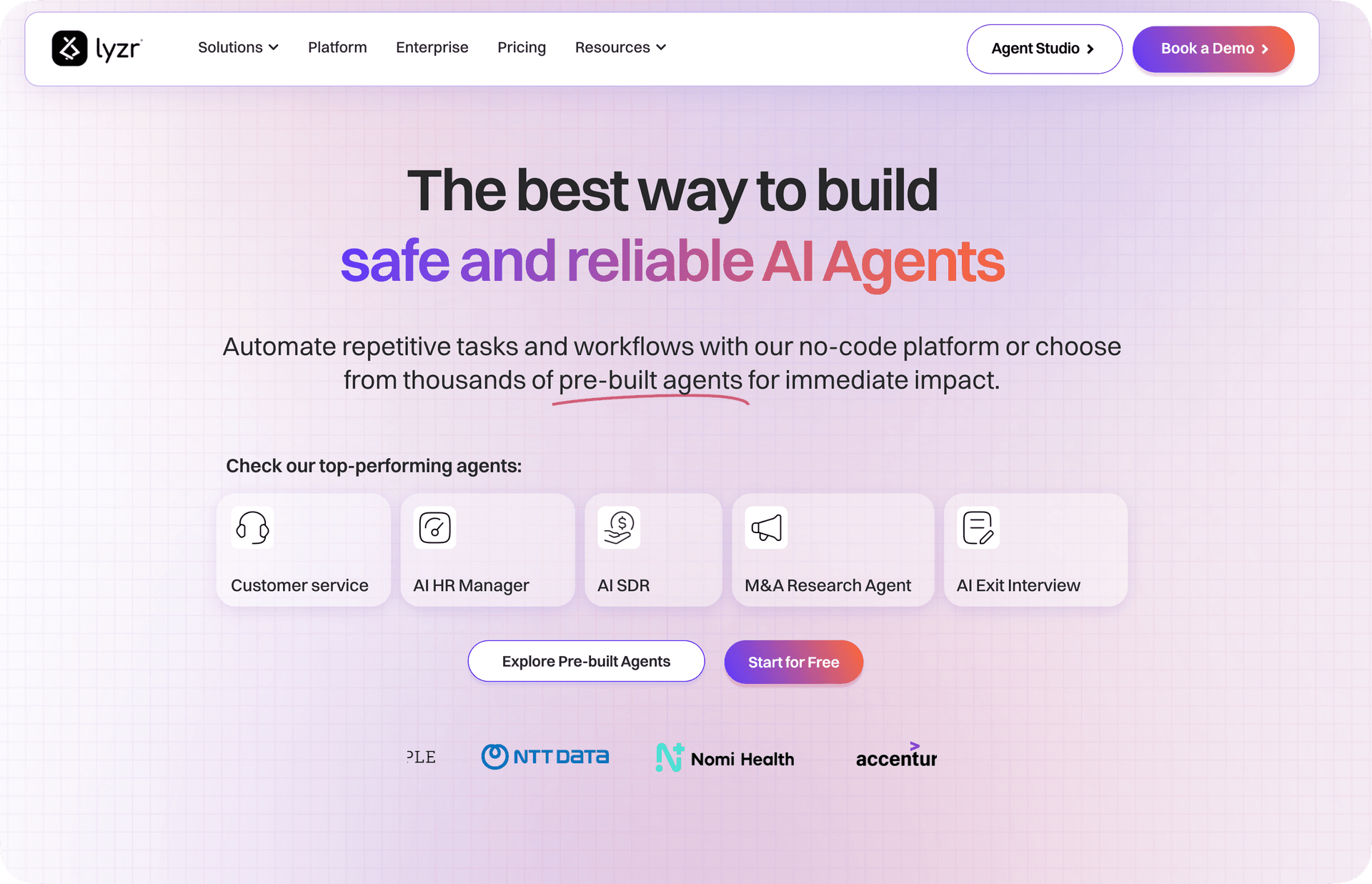
Lyzr is a low-code agent framework with an agentic approach to building generative AI applications. Its fully integrated agents come with pre-built RAG (Retrieval-Augmented Generation) pipelines, allowing you to build and launch AI-powered solutions within minutes. With Lyzr, you can create chatbots, knowledge search engines, data analysis tools, RAG-powered apps, and multi-agent workflow automations—all with minimal effort.
Key Features:
- Locally Deployable SDKs: Install and run Lyzr on your own cloud infrastructure to maintain complete data control.
- Private APIs: Keep your generative AI applications behind your company's firewall, ensuring strong data governance.
- AI Management System (AIMS): A central control hub to manage agents, monitor logs, build with AI studios, and track AI usage.
- Lyzr Automata: A multi-agent automation framework that focuses on workflow efficiency. Create multiple agents each with specific tasks and goals, running them independently or in parallel.
- Pre-Built RAG Pipelines: Easily implement retrieval-augmented generation for more contextually accurate AI responses.
- Minimal Learning Curve: A low-code approach makes it accessible to developers and enterprise teams alike.
Best For:
- Developers seeking a simple yet powerful framework to quickly build AI apps
- CTOs and CPOs wanting to integrate generative AI features into existing applications without exposing data externally
- CIOs requiring 100% data privacy and security, with the ability to locally host AI solutions
- Enterprises looking for easy management of multiple agents and comprehensive AI analytics
Not Suitable For:
- Hobbyists or very small projects that do not need enterprise-level data privacy or compliance
- Teams unwilling to manage their own infrastructure or cloud resources
3. CrewAI:
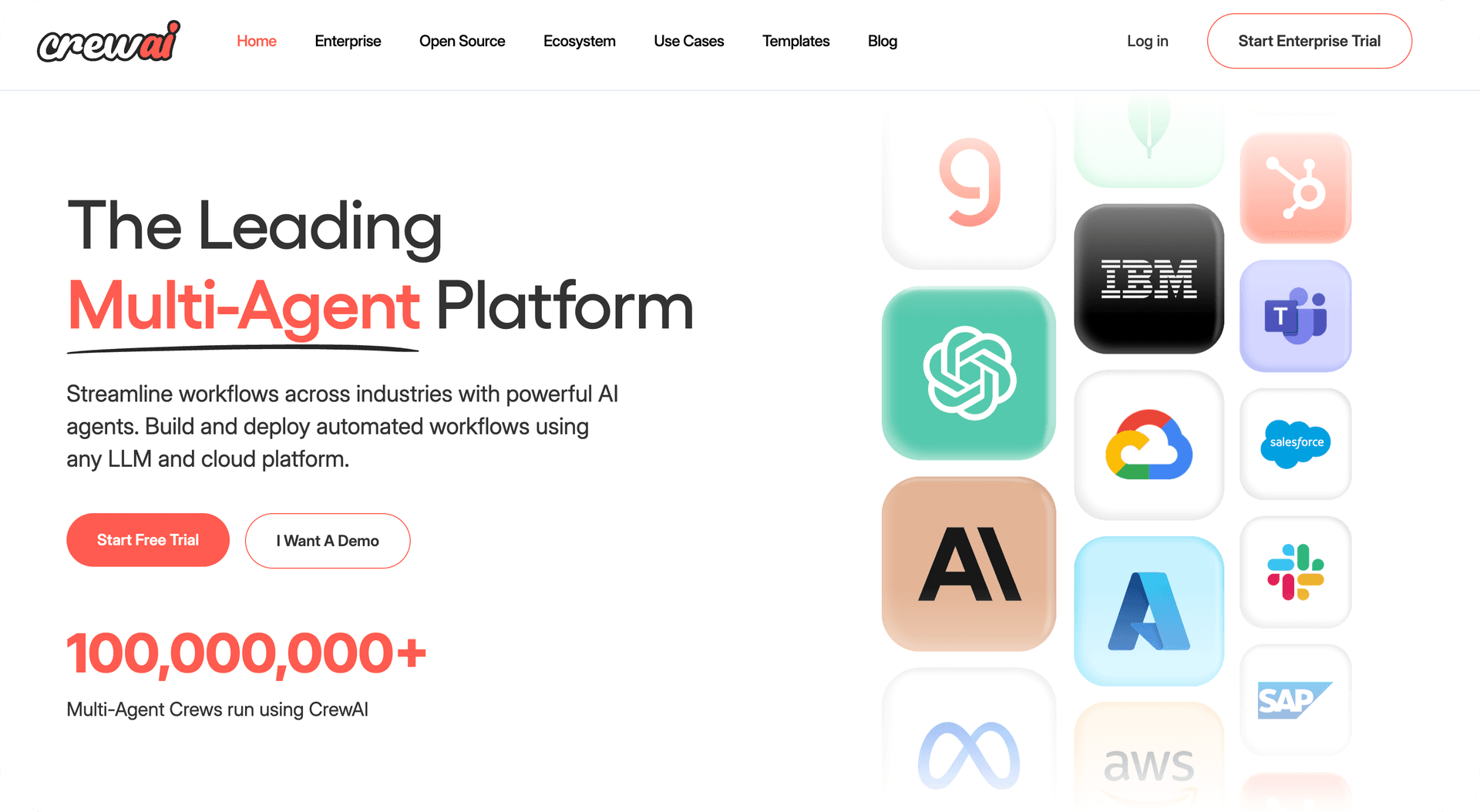
CrewAI is an open-source framework that enables developers to create advanced multi-agent AI systems with ease. It focuses on building teams of AI agents, each assigned specific roles and responsibilities, to work collaboratively on complex tasks. This role-based approach mirrors human organizational structures, making it effective for projects that require diverse expertise and coordinated efforts.
Key Features:
- Role-Based Agent Design: Create AI agents with specific roles, goals, and backstories to simulate a team with varied skills.
- Dynamic Task Planning and Delegation: Agents can plan tasks and delegate them among themselves based on their capabilities.
- Inter-Agent Communication: Supports advanced communication between agents to share information and coordinate actions.
- Flexible Memory Systems: Offers customizable memory options like short-term, long-term, and shared memory for better decision-making.
- Hierarchical Team Structures: Allows organizing agents in series, parallel, or hierarchical setups for scalable collaboration.
- Adaptive Execution Mechanisms: Enables agents to adapt their actions based on changing environments or new information.
- Extensible Tools Framework: Provides options to extend agent functionalities through integration with various tools and APIs.
Best For:
- Companies needing to automate complex workflows requiring multiple specialized tasks
- Developers building sophisticated AI systems that require team coordination
- Projects involving multi-step processes like content creation or financial analysis
- Organizations looking to simulate human team dynamics in AI systems
Not Suitable For:
- Simple automation tasks that don't require multiple agents
- Projects with limited computational resources
- Teams without technical expertise in AI development
- Small-scale operations with straightforward workflows
4. Autogen:
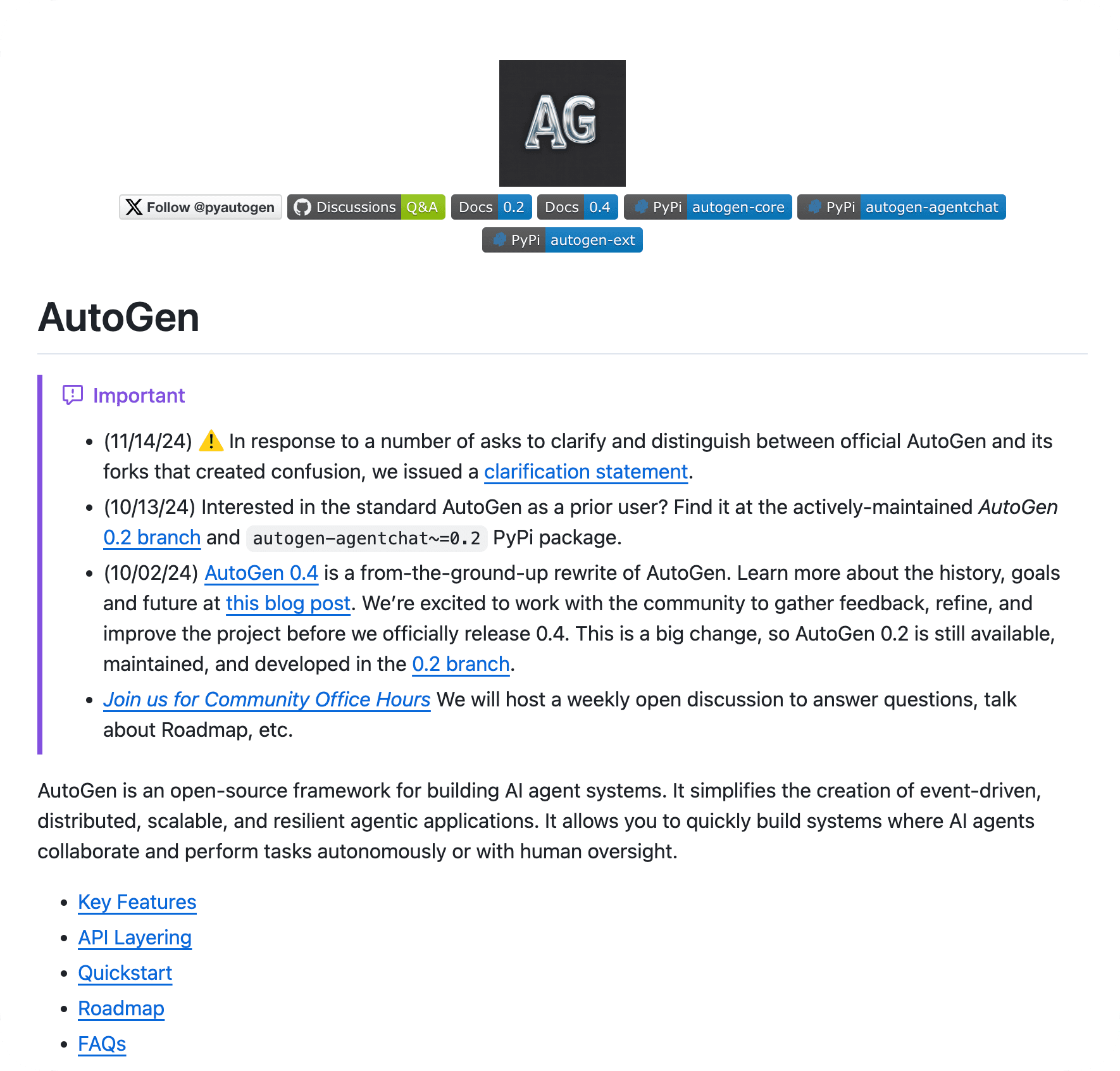
AutoGen is Microsoft's open-source framework for building and managing autonomous AI agents. It specializes in creating multi-agent systems where different AI agents can work together, communicate, and handle complex tasks independently, making it particularly powerful for enterprise-level applications.
Key Features:
- Multi-Agent Architecture: Supports systems where multiple AI agents collaborate to solve complex problems.
- Customizable Conversational Agents: Create agents with specific roles and behaviors that interact through conversations.
- Integration with Large Language Models (LLMs): Easily connects with various LLMs for advanced reasoning and language capabilities.
- Code Generation and Execution: Enables agents to generate and run code—useful for tasks like reviews, debugging, and prototyping.
- Flexible Human-in-the-Loop Controls: Supports human oversight where necessary, balancing autonomy with control.
Best For:
- Software engineering teams needing AI for coding tasks
- Organizations requiring strong data analysis pipelines
- Companies building advanced customer service automation
- Teams working on multi-step AI processes
Not Suitable For:
- Small-scale projects not requiring multiple agents
- Organizations with limited AI expertise
- Real-time systems requiring ultra-low-latency
- Budget-limited teams due to compute/model cost
5. Dify:
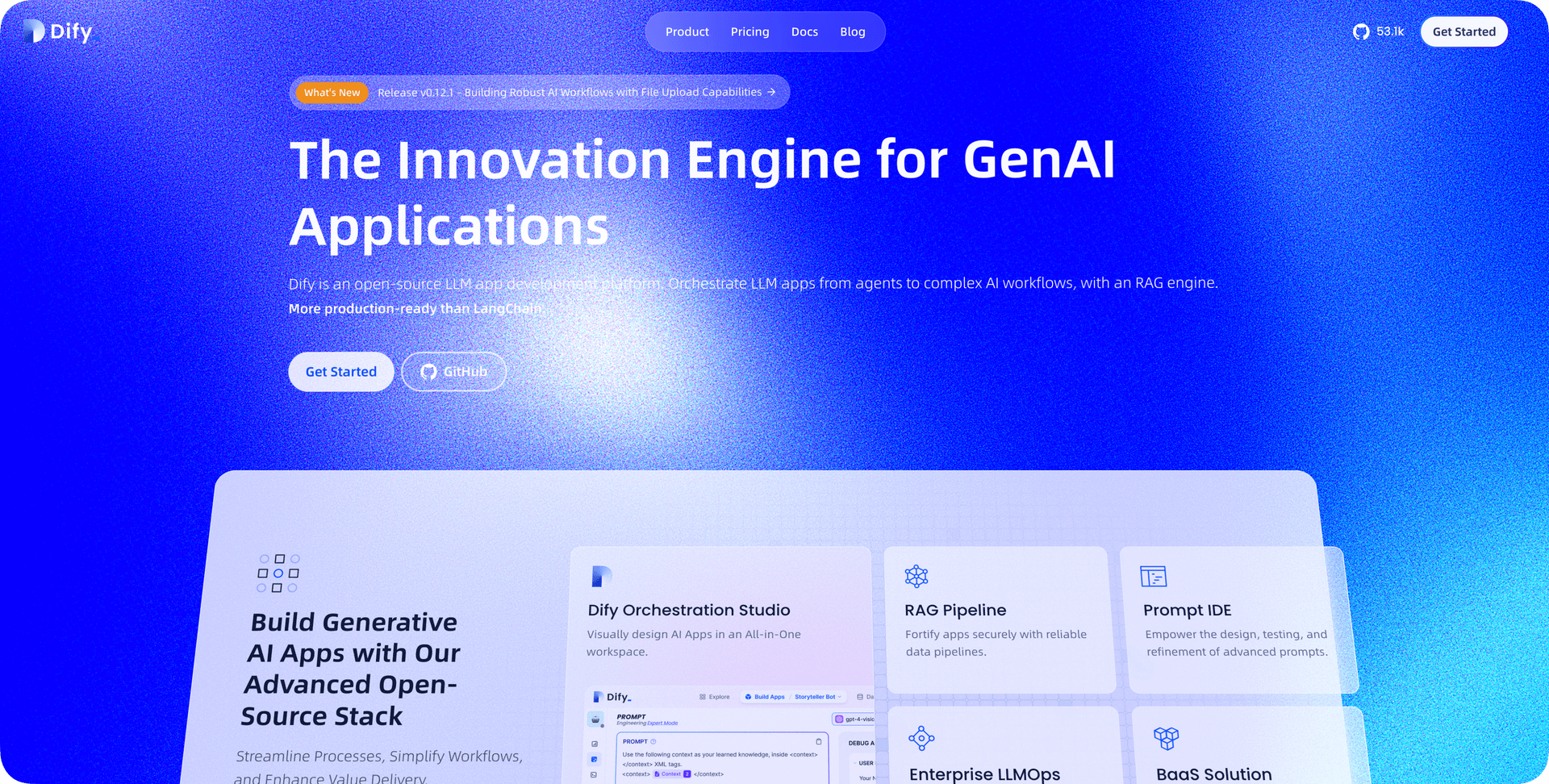
Dify is an open-source platform designed to simplify the development of LLM-based applications. It provides a complete suite of tools for building workflows, managing prompts, integrating multiple models, and deploying applications—ideal for both developers and non-technical users.
Key Features:
- Visual Workflow Builder: Design workflows using a visual canvas without writing heavy code.
- Extensive Model Support: Compatible with GPT, Llama3, Mistral, and any OpenAI-compatible model.
- Prompt IDE: Includes tools for crafting prompts, A/B testing models, and enhancing output.
- RAG Pipeline: Ingest PDFs, slides, and documents for retrieval-augmented generation.
- Agent Framework: Build agents using tools such as Google Search, DALL·E, Stable Diffusion, and WolframAlpha.
- LLMOps & Observability: Monitor logs, performance, and production data with built-in observability.
- Backend APIs: Every feature is available as an API for seamless integration.
- Cloud or Self-Hosted: Choose zero-setup cloud deployment or customize deeply with Community Edition.
Best For:
- Teams building production-ready AI apps quickly
- Non-technical users needing visual tools
- Companies requiring strong RAG pipelines
- Projects needing multiple model integrations
Not Suitable For:
- Highly specialized AI requiring custom architectures
- Teams needing deep algorithmic control
- Very low-resource teams needing extensive guidance
- Projects needing heavy custom ML logic
6. LangGraph:

LangGraph is a LangChain extension designed for building complex, stateful AI systems. It enables advanced planning, reflection, and multi-agent execution through graph-based workflows.
Key Features:
- Stateful Interactions: Maintain state across agent steps.
- Multi-Agent Coordination: Agents communicate and collaborate on tasks.
- Graph-Based Workflows: Visualize and structure complex execution flows.
- Flexible Paths: Supports both cyclic and acyclic execution.
- Error Handling: Built-in retries and error management.
- Customizable Nodes/Edges: Tailor workflows to domain-specific needs.
- Advanced Planning & Reflection: Supports reasoning-heavy decision cycles.
Best For:
- Teams building sophisticated interactive AI
- Multi-agent decision-making workflows
- Self-improving systems requiring reflection
- Organizations already using LangChain
Not Suitable For:
- Simple bots and automation
- Teams new to LLM development
- Projects with limited compute
- Tasks where agent self-talk is risky
7. Swarm:
OpenAI Swarm is an experimental lightweight framework for orchestrating multi-agent systems. It focuses on simplicity, developer friendliness, and fast prototyping.
Key Features:
- Agent Handoff: Pass context and tasks between agents smoothly.
- Lightweight Architecture: Minimal overhead for quick builds.
- Customizable Roles & Functions: Define small, modular agents with focused responsibilities.
- Context Variables: Share information across agents without persistent state.
- Client-Side Execution: Enhances privacy and doesn't store user data.
- Educational Examples: Includes learning-friendly templates.
Best For:
- Quick multi-agent prototypes
- Educational and experimental projects
- Teams needing simple agent orchestration
- Client-side privacy-focused use cases
Not Suitable For:
- Production systems
- Projects requiring robust error handling
- Complex agent reasoning or planning
- Systems needing vector DBs or persistent state
8. LlamaIndex:

LlamaIndex is a powerful data framework that connects LLMs to structured and unstructured data sources, enabling context-rich AI applications.
Key Features:
- Data Integration: Connects to PDFs, databases, APIs, web pages, and more.
- Efficient Retrieval: Query your data efficiently for high-context responses.
- Versatile Applications: Supports chatbots, QA engines, recommender systems, and agentic apps.
Best For:
- Teams building knowledge-heavy applications
- Q&A systems over large datasets
- Retrieval-centric AI systems
- Full-stack AI product development
Not Suitable For:
- Projects with minimal data
- Real-time high-speed data use cases
- Teams unfamiliar with LLM fundamentals
- Very small, low-context apps
9. LangChain:

LangChain is a modular, extensible framework for building advanced LLM applications. It remains one of the most popular toolkits for multi-model, multi-step AI workflows.
Key Features:
- Modular Architecture: Mix and match components easily.
- Unified LLM Interface: Connect to OpenAI, Anthropic, Hugging Face, Groq, and more.
- Rich Component Library: Prompts, vector stores, memory modules, tools, agents.
- Agent Tools: Build agents with tool use, planning, and external data access.
- Advanced Memory: Long-context management for deep conversations and multi-step tasks.
Best For:
- Developers building complex LLM pipelines
- Projects requiring multi-model integration
- Advanced chatbots & assistants
- Research-heavy or multi-source data tasks
Not Suitable For:
- Ultra-stable enterprise production
- Strict-budget teams (high token usage)
- Projects needing predictable execution speed
- High-traffic applications with strict RL limits
Choosing the right AI agent platform
When choosing an AI agent framework, consider the following:
Development Stage
- Experimentation: Swarm, CrewAI
- Production-ready: Dify, LlamaIndex, Lyzr
- Enterprise: LangChain, AutoGen
Technical Expertise
- Low: Dify, Lyzr
- Medium: CrewAI, Swarm
- High: LangChain, LangGraph, AutoGen
Comparison Table
| Platform | Best For | Strength | Technical Level | Prod Ready |
|---|---|---|---|---|
| Lyzr | All team sizes | Low-code builder | Low–Medium | Yes |
| CrewAI | Multi-agent collaboration | Role-based architecture | Medium | Yes |
| AutoGen | Complex workflows | Multi-agent orchestration | High | Yes |
| Dify | RAG apps | Visual workflow builder | Low | Yes |
| LangGraph | Stateful agent systems | Graph-based planning | High | No |
| Swarm | Simple prototypes | Lightweight design | Medium | No |
| LlamaIndex | Data-intensive apps | Data integration | Medium | Yes |
| LangChain | Flexible agent development | Modular architecture | High | Partial |
Final Recommendations
For Beginners
- Start with Lyzr AI
- Try OpenAI Swarm for quick prototypes
For Medium-Scale Projects
- Choose Lyzr AI for multi-agent apps
- Use LlamaIndex for data-heavy workloads
For Enterprise
- Implement AutoGen for complex orchestration
- Use LangChain for flexible, fully customizable pipelines